MYSTIKA
Ancestral paths to heal and restore our relationship with our land.
This is a pre-registration; the residency program is scheduled to begin in November 2026. A minimum of 20 registrations is required for the program to proceed.
COSMOTRIBUTE is an artistic residency that presents ancestral paths to heal and restore relationships with our territory. It is an artistic training that seeks to provide us with tools to face the climatic, social, environmental, and cultural challenges we are facing on a global level, through the re-signification of the relationships we maintain with our territory at a local level. Based on Jeisson Castillo 's experiences with indigenous communities in the Amazon and Andean regions of Colombia, with Castillo we will learn that there are ancestral forms and technologies of care that guarantee the conservation of nature and the well-being of communities. Forms and technologies that work and only make sense if we are able to understand that we are part of the network of beings and relationships that constitute nature itself. Generating this understanding requires a transformative process that moves between the personal and the collective, between the past, present, and future, between the local and the global, between the material and the spiritual. It is a process of healing from our colonial past of territorial uprooting and, in this sense, it is simultaneously a process of visualizing and materializing other possible futures, where we restore our place not as owners, but as guardians of our mother earth.
JEISSON CASTILLO

Tata Jaguar

Curacion del Territorio

Taita Curando Selva

Nueva Curacion del Mundo
Cosmogeography and Cosmopolitics
There is no doubt that we are in a moment of social, ecological, and cultural crisis. The challenges of global climate change are felt throughout our planet. These are not merely the result of a political and economic system that has opted for the uncontrolled exploitation and consumption of fossil fuels. They stem from a worldview, from a colonial history of uprooting that systematically broke the relationship of communities with their territory, replacing it with a bond of exploitation and destruction that is only possible from an epistemology that places humankind above nature. This worldview has not only led us to this catastrophe, but by keeping us immersed in this process of destruction, consumption, and propaganda, it makes us believe that there is no way out.
But the reality is that there are still communities, territories, and traditions that offer us alternative ways of relating to this land that, for our ancestors, is Mother Earth. Alternative ways exist because there is a different worldview, where the human being is not a superior being, but rather part of the network of beings and relationships that together constitute nature itself. These visions, originating from native peoples around the world, radically support different practices of relationship and care, which guarantee the well-being of human beings and the balanced conservation of nature, because they do not accept exploitation and destruction as a way of life.
Among these practices, one that is very important among the peoples of the Colombian Amazon is the establishment of social and political agreements with the owners and guardians of the forest. This has been called Cosmopolitics and arises from the recognition that every stone, cloud, lightning bolt, animal, plant, drop of water, flame of fire has a spirit, memory, and word.
Cosmopolitics does not exist in a vacuum, but has a geographical, geophysical, and historical order that serves as a guide for humankind. Communities that inhabit each territory to establish the correct relationships with the beings of nature—we call this Cosmogeography. In practical terms, this means that there is a territorial delimitation so that humans understand which areas are theirs to inhabit and which are theirs to care for. For native communities, knowing the cosmopolitics and cosmogeography of their territory is a complex way of life that depends on knowledge transmitted since time immemorial and which, due to its effectiveness in the conservation of territories, has begun to be recognized not only as intangible heritage of humanity, but as a solid strategy to be included in the plans of national natural parks such as the Yaigoje Apaporis National Natural Park located in the Colombian Amazon.
Although Jeisson Castillo arrived at cosmopolitics and cosmogeography through his experience of over 10 years among the indigenous peoples of the Amazon, of Andean origin, he took his time to investigate their existence in this territory. In the process, he was able to understand that, if not entirely, most native peoples coincide in their traditions with visions and practices equivalent to them, and that despite the colonial processes that attempted to extinguish them, vestiges continue to exist that will allow us to reconstruct them.
The reconstruction of cosmopolitics and cosmogeographies can be a major step in the planetary process of healing and re-signifying the relationships we maintain with our territory. It allows us to recognize that beings with whom we share the territory, whether plants, animals, rivers, or mountains, have the right to be respected and cared for, not because of the power we have as human beings over them, but because of their own existence and right. It also allows us to map the existence of sacred places and priority conservation sites, and to create guides for the different degrees of intervention we can exercise in the territory at the local level. Finally, it gives us the opportunity to practice spirituality linked to the care of the earth as a valid, important, and necessary way to do so in these times of crisis.
This is the path, and art will guide us along it.

Mystika
This Mystika: COSMOTRIBUTE is intended for artists and people involved in conservation, restoration, and territorial care processes who seek interdisciplinary tools to amplify their impact. In practice, it's for people who are willing to undertake an intense process of personal and community transformation. Specifically, it's for people who want to find in art a tool for research, analysis, production, and communication, and who are willing to explore their territory and engage with people in their community.
This is a pre-registration; the residency program is scheduled to begin in November 2026. A minimum of 20 registrations is required for the program to proceed.
As a methodology, we propose catalyzing experiences of recognition and restoration of territorial ties in three dimensions: the material dimension, the historical dimension, and the spiritual dimension. In this process, art serves as an excuse and a guide, a research strategy and a pedagogy, a means of reflection and contemplation. Generating communication, so that the individual work developed by each participant organically connects.
The participants' experiences can be expanded and replicated within their families, communities, and territories. We will guide participants in recognizing these dimensions (material, historical, and spiritual), while introducing concepts, presenting references, explaining methods, and sharing experiences that inspire and guide participants in developing their individual practice. We will open spaces for collective dialogue so that each participant can present their progress and receive feedback.

Reference Professor
Jeisson Castillo is a Colombian visual artist and researcher who has immersed himself in the ancestral wisdom of Colombia's peasant and indigenous communities. His artistic proposals combine painting, performance, video, magic, and anthropological research to create bridges with coherent proposals for life in the territory. In particular, he has explored the use of plants and sacred entities to give spirit to his images. In recent years, he has traveled extensively through the Colombian Amazon, where he has worked alongside different indigenous peoples who persevere in safeguarding their traditions and territories. His work has been exhibited in universities, galleries, and malocas (traditional indigenous houses) in Colombia, the United States, Latin America, and Europe.
How to get there
📍 Location
Coordinates: -27.471546, -48.527664
Tip: The location is at the end of the Sambaqui neighborhood. The last 800 meters are on a dirt road (Uber usually goes up that road, but it's good to let them know).
✈️ Arriving by Plane
Fly to Florianópolis International Airport (FLN).
Frequent connections via São Paulo (GRU/CGH), Rio de Janeiro (GIG) or Buenos Aires (EZE).
🚗 Leaving the Airport
Uber/99: Average cost between R$ 65.00 and R$ 95.00.
Time: Approximately 45-60 minutes.
Note: We will use ride-hailing apps for all travel and sightseeing in the area.
Useful Information
Voltage: 220V | Plug: Brazilian Standard (Type N - three pins).
Visa: Check if your country requires an e-Visa (USA, Canada, and Australia). 👉 brazil.vfsevisa.com
rodrigonini@gmail.com
+55 19 984-0800-77
Health: Yellow fever vaccination is recommended (at least 10 days before travel).
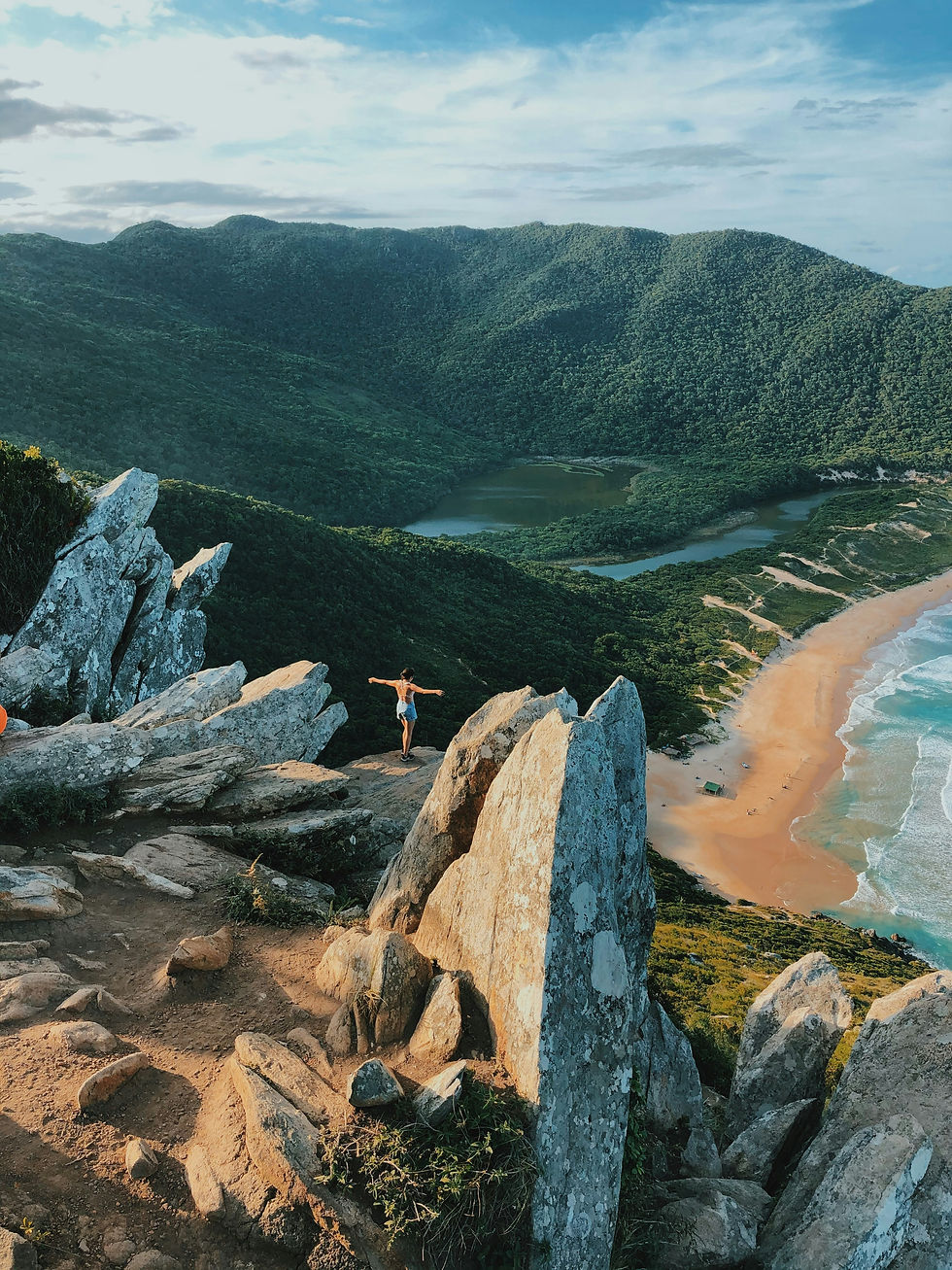
Our residency will take place in Florianópolis, on the island of Santa Catarina (parallels 27°22′-27°50′, meridians 48°25′-48°35′) , in southern Brazil. It has 423 square kilometers and 172 kilometers of coastline with 42 beaches and great ecological diversity, including marine estuaries, mangroves, dunes, lagoons, rocky cliffs, islets, and regions still covered by the marvelous Atlantic Forest, one of the world's richest ecosystems in terms of biodiversity.
The city of Florianópolis has approximately 350,000 inhabitants, most of whom are concentrated in the central area, which is divided between the island and the mainland, connected by bridges. It is the capital of the state of Santa Catarina, one of the richest in Brazil, with a population that is predominantly of European origin (Portuguese, Italian, German, and other nationalities). Florianópolis has an airport with several daily flights to São Paulo, Rio de Janeiro, and Buenos Aires.
We will be staying on the northern part of the island, facing the mainland and the Daniela peninsula, about 25 kilometers from the city center, with the last 800 meters on a dirt road that ends near the house. The location is blessed with the sounds of nature and tranquility. The sound of the ocean waves can be heard in the background. Although the surrounding hills were partially cultivated until the 1970s, there are still small, beautiful pockets of Atlantic Forest, with dozens of species of orchids and bromeliads, as well as many species of birds and insects (mainly butterflies), lizards, and some snakes. The sunsets are often spectacular. Scorpio and the Southern Cross are constellations especially visible on clear winter nights.
A ten-minute walk from the house, there is a pleasant beach. A twenty-minute walk away, you'll find a fishing village with a rich community life, a beautiful park, schools, two markets, craft shops, tranquil beaches, and excellent restaurants. This area is the island's largest producer of mollusks, a pilot project developed by the Federal University of Santa Catarina.